Imagine this: Your café is bustling and busy with happy faces and fresh coffee, serving the local community with a smile. But the smile falters beneath the surface, as the buildup of tetrapak and unrecycled packaging raises some guilt about the state of recycling for our planet. Have you been there?
Every food servicer faces the same dilemma: how to balance safety, shelf life, and sustainability. Composite packaging, such as Tetra Pak cartons, plays a vital role in protecting products; however, for many years, its multi-layer design has made it difficult to recycle effectively in New Zealand.
That’s now changing thanks to a local partnership that’s transforming post-consumer cartons into high-performance building materials, giving packaging a second life and helping food producers close the loop on waste.
Tetra Pak cartons are made from a blend of paperboard, plastic, and aluminium, a smart combination that keeps food safe and shelf-stable. However, this very strength makes recycling a complicated process. Traditional recycling facilities struggled to separate and recover these materials, resulting in many cartons being sent to landfills despite being theoretically recyclable.
For food service businesses committed to sustainability, this created a frustrating gap between packaging innovation and waste recovery capability.
SaveBOARD is a New Zealand company pioneering a simple but transformative idea: instead of separating the layers, why not reuse them as they are?
They take beverage cartons (including Tetra Pak and similar packaging) to create low-carbon construction boards. Waste streams are sourced from a mix of community drop-off points. The boards are made from composite materials, including packaging such as milk cartons (both aseptic, or silver-lined, and gable-top), ingredient bags, coffee cups, and soft plastics.
“Nothing added, just everyday packaging waste under pressure, heat and time to make our products.” (SaveBOARD)
These boards replace materials such as plasterboard, MDF, and plywood in commercial and residential buildings, all without the use of adhesives, resins, or added chemicals.
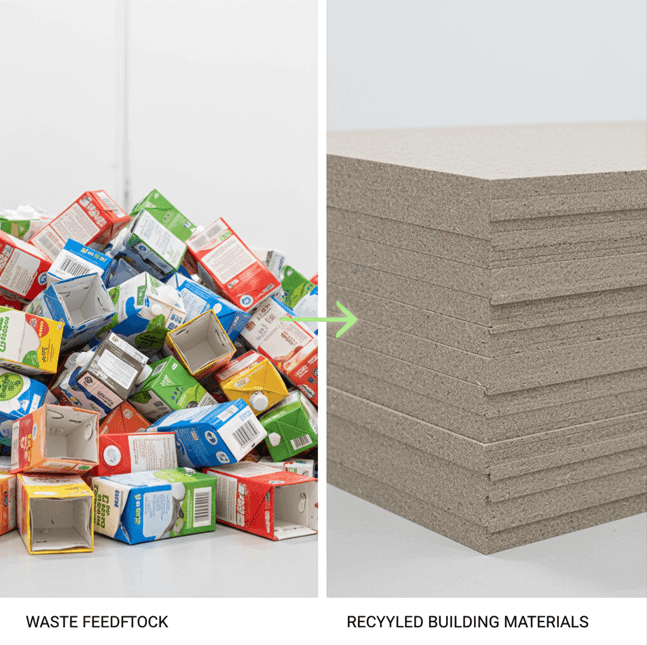
The facilities in Hamilton and Warragul (Australia) now process millions of beverage cartons every year. The result?
- Tens of thousands of tonnes of waste diverted from landfill
- Lower carbon emissions compared to conventional building board production.
- A domestic market for recovered packaging, reducing dependence on overseas recycling solutions.
For the food service businesses, this represents a tangible step toward circular manufacturing, where packaging isn’t simply disposed of but re-imagined as a resource for another sector.
Learn more about how the company transforms cartons into building materials on
their website.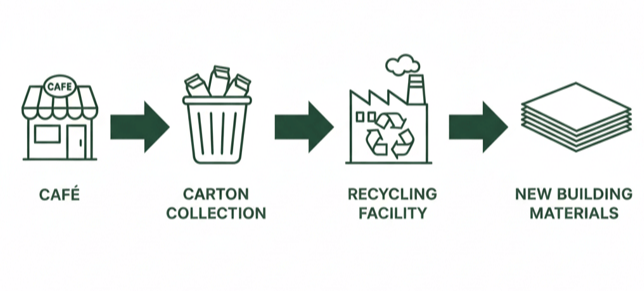
Collaborations like this are more than a recycling story, it’s a model for systems thinking in food production. By engaging with circular partners, brands can demonstrate leadership on sustainability without compromising product integrity or compliance.
Here’s how your business can contribute:- Check your waste streams. Are beverage cartons being sent to landfills at the moment? Explore collection or baling options for recycling.
- Engage your waste contractor. Many service providers now partner directly ,ask if carton recovery can be included in your recycling plan.
- Communicate your efforts. Sharing sustainability wins helps build brand trust with consumers, auditors, and partners.
In a world where sustainability is increasingly linked to reputation and resilience, examples like SaveBOARD show what’s possible when innovation meets collaboration.
Every carton that becomes a building board instead of landfill waste represents a small victory, for the planet, for consumers, and for the integrity of the food industry itself. By turning waste into value, New Zealand’s food businesses can help build more than just products, they can help create the future.
Sustainability is rapidly becoming an integral part of compliance and customer expectations, particularly in an industry founded on trust and care. Innovations like this show what’s possible when collaboration meets purpose, and how cafés can play their part in protecting both people and the planet.
Food Surety helps food professionals lead with
confidence in food safety, quality, and sustainability. Because when knowledge turns into action, everyone wins.